
What happens to your piano
Parting with a piano is often harder than people expect. Here is exactly what happens to your piano, from the moment we arrive to the certificate in your inbox, so there are no surprises on the day.

Six steps, and you lift nothing
Every collection follows the same pattern, whether it is an upright in a front room or a grand at the top of the stairs.
You show us the piano
When we arrive, you show us the piano and the way out. If there is more than one possible route, we will look at them with you and choose the safest.
We photograph it where it stands
Before we touch it, we photograph the piano using our own disposal software. The photo goes straight to our own servers, not to a third-party app.
We carry it out
Our team protects your floors and doorways and does all the lifting, from any floor, over steps and through tight turns. A grand has its legs, lyre and pedals taken off and travels on its side.
Your disposal certificate
After collection we email you a certificate with a unique number, the date, the waste code your piano is recorded under and our waste carrier licence.
A farewell image
At the bottom of that email is a farewell image of your piano, made from the photo we took. Click it and it opens the real photograph.
Taken apart and recycled
Back at our yard, never in your home, the piano is stripped down by hand so the iron, steel and timber can be recycled. How we recycle pianos.
Your certificate of piano disposal
Householders do not need a waste transfer note by law. We send one anyway, because we think you should know exactly who took your piano and where it went.
The certificate tells you:
- Who collected it, and that it was carried under our Environment Agency waste carrier licence, CBDU133377.
- The waste code it is recorded under. For an acoustic piano that is normally 20 03 07, bulky waste.
- A unique certificate number and the date, so the collection can be traced if anyone ever asks.
It is a useful thing to keep. Householders have a legal duty of care to give their waste only to an authorised carrier, and if a piano is fly-tipped, the household it came from can be held responsible. Your certificate shows you did the right thing. You can check any waste carrier, including us, on the Environment Agency public register.
Certificate of Piano Disposal
This is to certify that Piano Disposal UK have taken your piano away for disposal and recycling. All pianos are recycled as much as possible.
Your piano has been collected and transported under our Environment Agency waste carrier licence no. CBDU133377.
The waste code used for the disposal is 20 03 07, bulky waste.
 Click image to view original collection photo. Link available for 30 days.
Thank you for helping us recycle responsibly.
An example based on a real certificate, with the customer’s details left out. Try clicking the image.
The farewell image
When a piano leaves a family home, it is not just furniture going out of the door. Often it belonged to a parent or grandparent, and saying goodbye to it is part of saying goodbye to them.
So rather than the last memory being a piano disappearing into the back of a van, we give it a gentler send-off. The photograph we take on collection day goes to our own servers, where AI turns that particular piano into a farewell image: the same instrument, at rest in a summer meadow at sunset.
It is not a real photograph, and we do not pretend it is
The meadow is imagined. The piano in it is yours. Click the image in your email and it opens the real photograph, exactly as your piano stood on the day.
What we keep, and for how long
We keep the real photograph for 30 days, so you have time to save a copy if you would like one. After that the link stops working. We do not keep the farewell image on our servers; it is yours, in your email.

The baby grand that still had its warranty
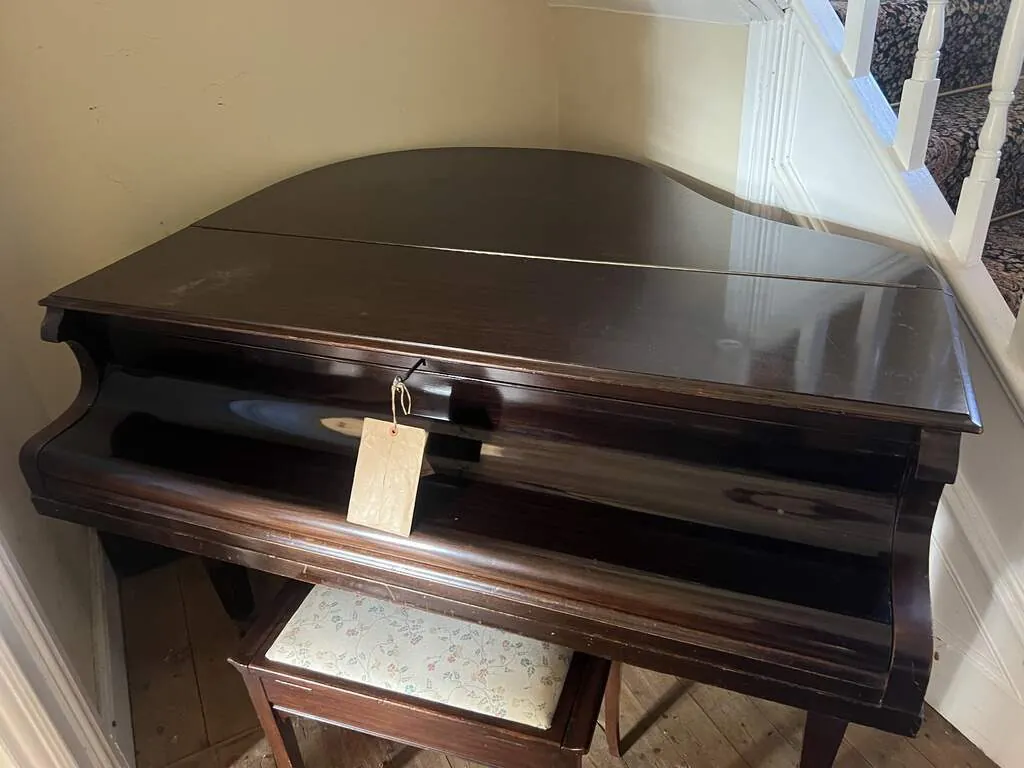
The piano in the photos on this page is a mahogany Amyl baby grand, made by the Co-operative Wholesale Society and collected from a family home in north Sheffield. Its owner had bought it brand new, and he had kept everything: the key on its original string, the maker’s tag, the envelope the warranty came in, and the certificate itself, which promised five years’ cover. His family joked that it had only just run out.
They were clearing the house after losing both parents, and the piano was one of the last things to go. It went with its farewell image, like every piano we collect. Our sister company, Yorkshire Piano Logistics, carried out the collection and wrote up the full story of its final send-off.
Collection day and your certificate, answered
Do I get a waste transfer note when my piano is collected?+
Householders do not need a waste transfer note by law, but we give every customer a disposal certificate anyway. It is emailed to you after collection and carries a unique certificate number, the date, the waste code your piano is recorded under and our Environment Agency waste carrier licence number, CBDU133377.
What waste code is used for piano disposal?+
An acoustic piano is normally recorded as 20 03 07, bulky waste. A digital piano is electrical equipment (WEEE) and is recorded differently, so we handle it under a different code.
Why does it matter who takes my piano away?+
Householders have a legal duty of care to give their waste only to someone authorised to carry it. If a piano handed to an unregistered collector is later fly-tipped, the household it came from can be fined. Using a registered waste carrier, and keeping the certificate, protects you.
Is the farewell image a real photograph?+
No. It is made by AI from the photograph we take of your piano on collection day, showing the same instrument at rest in a summer meadow. It is there to give your piano a gentler send-off, not to pass for a real photo. Clicking it in the email opens the real photograph.
How long do you keep the photo of my piano?+
The real photograph is kept for 30 days, so you have time to open it from the email and save a copy. After that the link stops working. We do not keep the farewell image on our servers.
Do you take my piano apart in the house?+
No. Pianos are broken down for recycling at our yard, never in your home. The only exception is a grand, where the legs, lyre and pedals come off so it can be carried out on its side.
Got a question to ask us?
Ask in your own words and get an answer straight from this website, any time of day.
Ready to have your piano removed?
Chat with us today and let’s get you a price worked out. No forms to fill in, just a friendly chat page